
 Čeština
 English
- Nowy

cfDNA from urine
5 mL sample
Elution from 10 µL
Description:
Urine Cell-free DNA Extraction Kit (Magnetic Beads), Cat. # 50103, is a kit for efficient extraction of cell-free DNA (cfDNA) from 5 mL of fresh or frozen urine. Urinary cfDNA carries valuable genetic and epigenetic information, making it a powerful tool for biomarker discovery in cancer and other disease research. Urine offers two key advantages as a source for biomarker discovery: larger sample volumes can be obtained compared to plasma or serum, and urine collection is truly non-invasive. In addition, the same individual can provide repeated samples over time, enabling longitudinal studies. DNA in urine is primarily derived from cells shed from the urinary tract. During apoptosis and necrosis, chromosomal DNA is fragmented, a process that is more pronounced under pathological conditions including cancer development, inflammation and immune responses, so urine cfDNA is typically highly degraded, with fragments around 100 bp or shorter. Sample composition can vary significantly between individuals due to cellular heterogeneity, health and disease status, stress levels, medical treatments and other factors. The kit uses magnetic bead technology, a simple method suited to recovering cfDNA from both fresh and frozen urine samples, and eliminates tedious spin column and vacuum filtration steps. Recovered DNA fragments can be eluted in volumes as low as 10 µL, enabling high-concentration yields for sensitive applications. The extracted cfDNA is compatible with a wide range of downstream techniques, including bisulfite sequencing, next-generation sequencing (NGS), microarray, PCR, qPCR and more.
The image shows an electrophoretic gel-like trace of DNA extracted from urine (samples A and B). On the left is a size marker ranging from 35 bp to 10,380 bp (bands at 100, 150, 200, 300, 400, 500, 600, 700, 1000, 2000, 3000, 7000 and 10,380 bp); the upper and lower edges of the trace are marked with a purple (10,380 bp) and a green (35 bp) reference band. In sample A, there is a distinct band just above 100 bp and above it a broad smeared signal extending approximately from 200 bp up to the upper edge of the trace, with a darker region around 2000–3000 bp. In sample B, there is a distinct band between 150 and 200 bp and above it a weaker, more even smeared signal reaching the upper edge.

Features:
Applications:
Workflow:
5 mL of urine is mixed with Urine Lysis Buffer, Urine-A Beads and Proteinase K in a 15 mL tube and mixed for 5 minutes on a rotator. This is followed by incubation for 45 minutes at 56 °C with occasional mixing. The tube is placed on a magnet, where the beads are captured and the supernatant is slowly and completely removed. The beads are washed with GSO Buffer and 80% isopropanol and, after THP Buffer and SPT Buffer are added, the DNA binds to the beads again. Two washes with 80% ethanol and drying of the beads on the magnet for approximately 10 minutes follow. Finally, the DNA is released from the beads into the elution buffer (10 mM Tris-HCl, pH 8.0), low TE or TE buffer and, after a short magnetic separation, the supernatant containing the DNA is transferred to a new tube or plate.

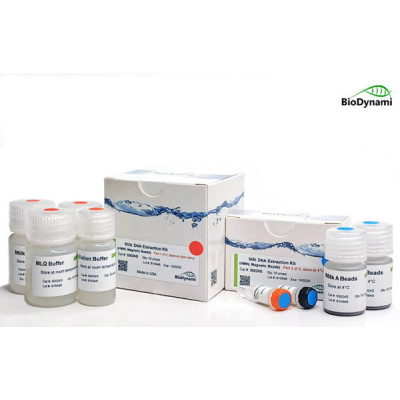
Kit contents:
Equipment and reagents required but not included: magnetic particle concentrator, vortexer, rotator, heat block, incubator or water bath, 96-well plates or 96-deep well plates, microfuge tubes, 15 mL tubes, 80% isopropanol and 80% ethanol (prepare before use).
Specification:
| Parameter | Value |
|---|---|
| Technology | magnetic beads |
| Sample type | fresh or frozen urine |
| Sample volume | 5 mL |
| Typical yield | 0.5–20 ng/mL from healthy donors |
| Fragment sizes | from 60 bp to > 10 kb (genomic DNA) |
| Elution volume | from 10 µL |
| Elution solution | elution buffer (10 mM Tris-HCl, pH 8.0), low TE or TE |
| Purity | cfDNA is NGS and PCR ready, typical A260/A280 around 1.8 |
RNA removal
RNase A free
Magnetic beads
Disposable pestle
Tissue homogenization
RNase- and DNase-free
cfDNA and cfRNA
From plasma and serum
Elution from 10 µL
cfDNA 50–500 bp
90% yield
compatible with automated systems
plasmid purification
removal of RNA
DNA from milk
Centrifuge-free
Including mastitic milk
Disposable set
Tissue homogenization
RNase- and DNase-free
DNA removal
RNA purification
Magnetic beads
HMW genomic DNA
Column-free
Centrifuge-free
Disposable set
Tissue homogenization
RNase- and DNase-free
DNA removal
RNA purification
Magnetic beads
DNA from milk
Centrifuge-free
Including mastitic milk
Total RNA from bacteria
No phenol, no chloroform
No DNase treatment
tRNA from bacteria
Without large RNA
No phenol, no chloroform
Plasmid DNA
Centrifuge-free
Directly from culture
Plasmid DNA
96-well plates
From 0.2 mL culture
cfDNA from urine
5 mL sample
Elution from 10 µL