
 Čeština
 English
- Nowy
DNA from milk
Centrifuge-free
Including mastitic milk
Description:
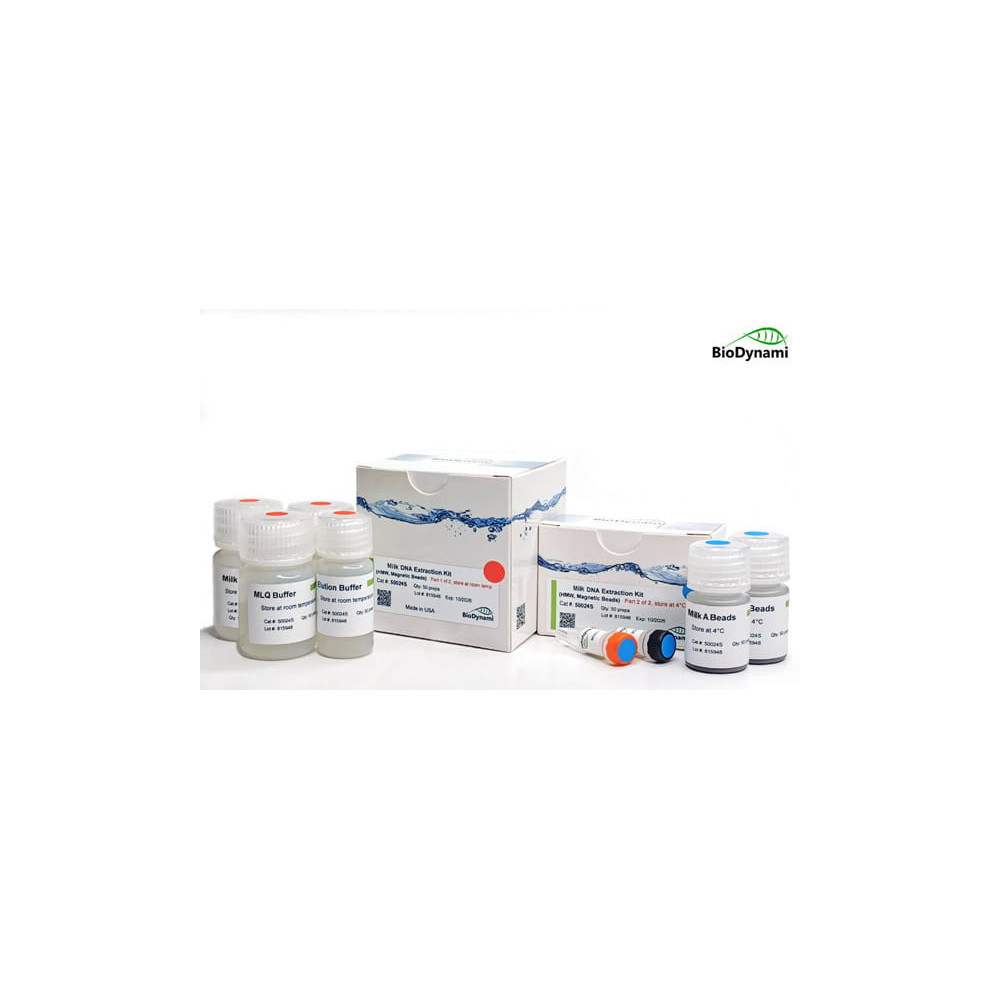
Milk DNA Extraction Kit (Magnetic Beads) is a kit for extracting nucleic acids from various sources in milk, including bacteria (both gram-negative and gram-positive), fungi, yeast and host cells. It is also suitable for extracting DNA from mastitic milk samples. The magnetic bead-based kit offers a simple and reliable method for DNA extraction from milk samples, eliminating the need for tedious centrifugation steps. The process begins with enzymatic digestion and lysis, which breaks down bacteria, yeast, fungi and host cells. Magnetic beads are then added to bind the DNA released from the lysed cells. After the initial DNA separation from the beads, a second bead-binding step removes additional impurities. Finally, the DNA is washed with ethanol and eluted in elution buffer or TE buffer. The standard input volume for milk is 500 µL. The yield of extracted DNA may vary depending on the bacterial species, the type of milk and the cell density. The extracted DNA is suitable for a wide range of downstream applications, including PCR, qPCR, hybridization, restriction digestion, DNA sequencing and next-generation sequencing (NGS).
DNA from milk samples was isolated and loaded on a 1% agarose gel together with the BioDynami 1 kb DNA Ladder.

Features:
Applications:
Workflow:
Proteinase K and lysis buffer are added to 500 µL of milk and the sample is incubated at 56 °C (for gram-positive or unknown bacteria, lysozyme can be added beforehand). After Milk A magnetic beads are added, the DNA binds to the beads, the tube is placed on a magnet and the supernatant is removed. The beads are washed with ISG Buffer and the DNA is released into MLQ Buffer. In the second step, Milk B Beads are added, which bind the DNA again and remove additional impurities. The beads are washed twice with 80% ethanol and briefly dried. Finally, the purified DNA is released from the beads into the elution buffer or TE buffer and, after magnetic separation, the supernatant containing the DNA is transferred to a new tube.

Kit contents:
Equipment and reagents required but not included: magnetic particle concentrator, vortexer, heat blocks, 1.5 mL and 2.0 mL tubes, isopropanol (for preparing ISG Buffer from the supplied Pre-ISG Buffer), 80% ethanol (prepare before use).
Specification:
| Parameter | Value |
|---|---|
| Technology | magnetic beads |
| Milk input volume | 500 µL |
| DNA sources | bacteria (gram-positive and gram-negative), yeast, fungi, host cells |
| Elution volume | more than 20 µL (20–50 µL according to the protocol) |
| A260/A280 | around 1.8 |

Disposable pestle
Tissue homogenization
RNase- and DNase-free
cfDNA from urine
5 mL sample
Elution from 10 µL
cfDNA 50–500 bp
90% yield
compatible with automated systems
RNA removal
RNase A free
Magnetic beads
cfDNA and cfRNA
From plasma and serum
Elution from 10 µL
plasmid purification
removal of RNA
DNA removal
RNA purification
Magnetic beads
Disposable set
Tissue homogenization
RNase- and DNase-free
gDNA purification
95% efficiency
removal of RNA
tRNA from bacteria
Without large RNA
No phenol, no chloroform
Plasmid DNA
Centrifuge-free
Directly from culture
DNA from milk
Centrifuge-free
Including mastitic milk