
 Čeština
 English
Description:
Prokaryotic Argonaute (pAGO) is the pivotal enzyme in the host defense system by mediating nucleic acid molecules. As the DNA-guided endonuclease from eubacterium Thermus thermophilus, TtAGO protein targets cognate DNA without the restriction of a PAM (protospacer adjacent motif) or PFS (protospacer flanking site) on the target sequence, expanding the selection range of available target DNA sequence. Besides, compared with CRISPR/Cas systems, TtAGO have remarkable advantages as TtAGO endonuclease utilizes guide DNA rather than guide RNA in directing target DNA cleavage, which is more convenient for in vitro applications as guide DNA is more stable in ambient temperature, easier and cost-saving to synthesize than guide RNA. These capacities enable TtAGO as a powerful programmable DNA endonuclease directed by short guide DNAs in efficient Nucleic Acid Detection systems as well as in versatile Synthetic Biology platforms.
The enzyme's purity is greater than 95%, as determined by SDS-PAGE and FPLC.
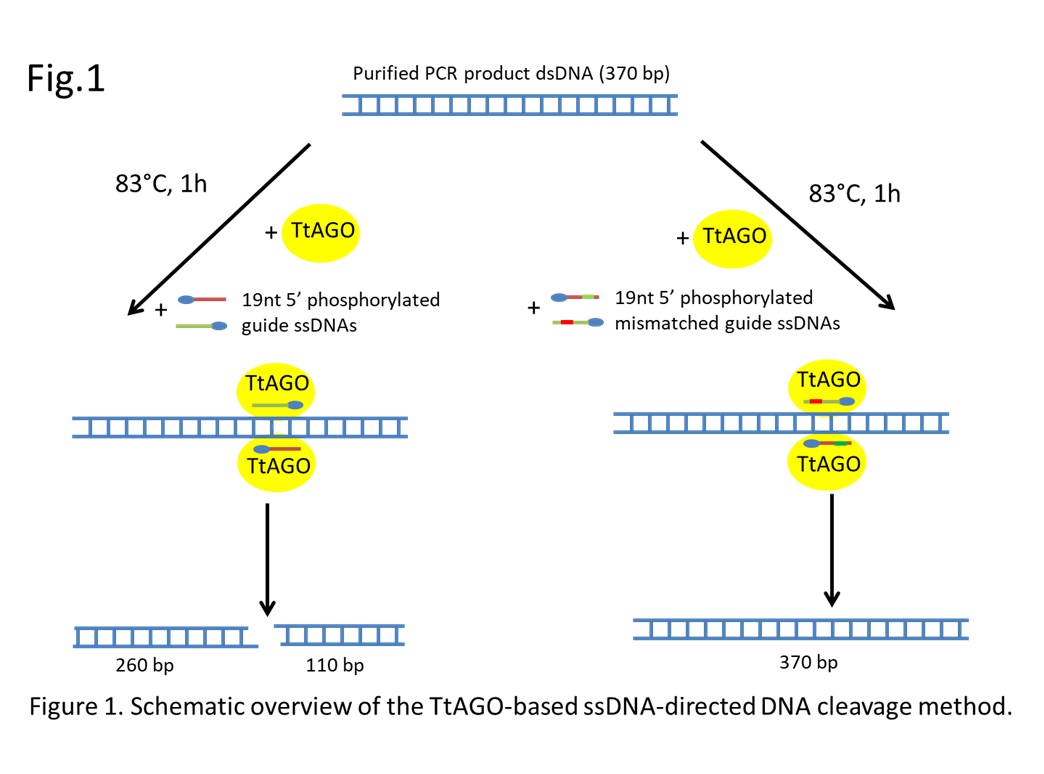
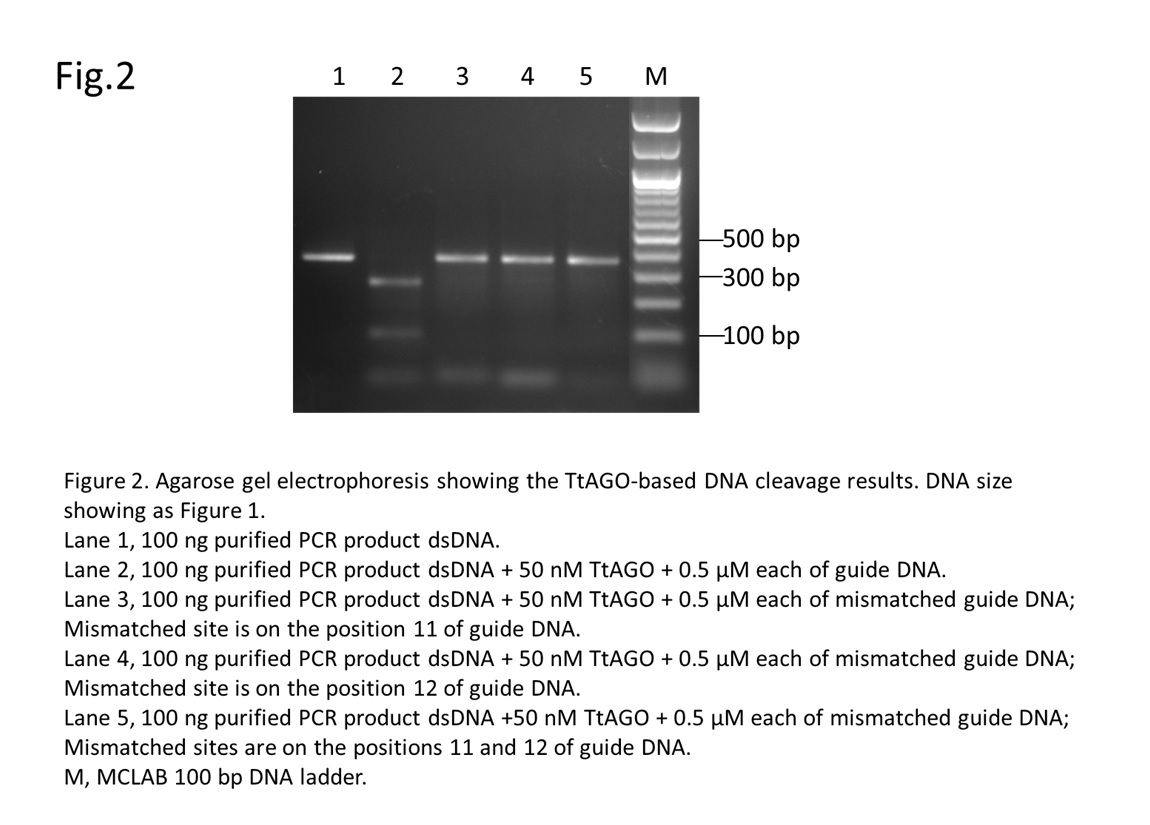
Activity: Purified 370 bp PCR product of dsDNA cleaved after 1 hour of reaction at 83°C.
Figure 1 shows a schematic representation of DNA cleavage directed by ssDNA using TtAGO. The results of DNA cleavage using TtAGO are shown in Figure 2.
Application:
Source:
TtAgo gene from Thermus thermophilus (NCBI Reference Sequence: WP_011174533.1) expressed in E. coli.
Storage:
-20°C
Size:
200 pmol, 200 ul (1 uM) (cat.n. TtAGO-10)
1 nmol, 200 ul (5 uM) (cat.n.. TtAGO-50)
LbCas12a (D832A, with an Asp832→Ala substitution)
Origin: Lachnospiraceae bacterium (strain ND2006)
Purity > 95%
Fast and simple fragmentation
Fragment size easily controlled by incubation time
Ideal for NGS library preparation
Adaptive immune systems from prokaryotes utilize clustered regularly interspaced short palindromic
repeats (CRISPRs) and CRISPR associated (Cas) proteins to cleave foreign genetic material. Cas13a, (previously referred to as C2c2) is part of the Type VI CRISPR-Cas system.
Adaptive immune systems from prokaryotes utilize clustered regularly interspaced short palindromic repeats (CRISPRs) and CRISPR associated (Cas) proteins to cleave foreign genetic material. Cas13a, (previously referred to as C2c2) is part of the Type VI CRISPR-Cas system.
Cas9 Nuclease, Streptococcus pyogenes, is an RNA-guided endonuclease that catalyzes site-specific cleavage of double stranded DNA.
CRISPR-Cas systems are powerful tools for mediating nucleic acids. Cas12a (also referred as Cpf1) nuclease belonging to the Class 2, Type V CRISPR system.
Benzonase endonuclease from Serratia marcescens, can be used to degrade all forms of DNA and RNA while having no proteolytic activity.
Adaptive immune systems from prokaryotes utilize clustered regularly interspaced short palindromic repeats (CRISPRs) and CRISPR associated (Cas) proteins to cleave foreign genetic material. CasRx, Cas13d from Ruminococcus flavefaciens XPD3002, is highly active and short, 94KD.
Fast and simple fragmentation
Fragment size easily controlled by incubation time
Ideal for NGS library preparation
Fast and simple fragmentation
Fragment size easily controlled by incubation time
Ideal for NGS library preparation
Adaptive immune systems from prokaryotes utilize clustered regularly interspaced short palindromic repeats (CRISPRs) and CRISPR associated (Cas) proteins to cleave foreign genetic material. CasRx, Cas13d from Ruminococcus flavefaciens XPD3002, is highly active and short, 94KD.
Benzonase endonuclease from Serratia marcescens, can be used to degrade all forms of DNA and RNA while having no proteolytic activity.