
 Čeština
 English
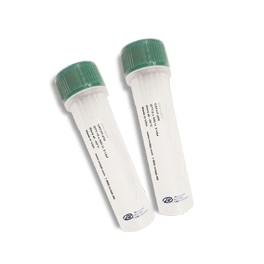
Description:
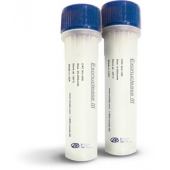
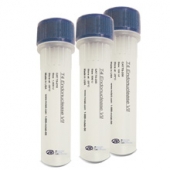
T7 Exonuclease is similar to Lambda Exonuclease in that it catalyzes the stepwise hydrolysis of duplex DNA from the 5'-termini, liberating 5'-mononucleotides. However, unlike Lambda Exonuclease, the enzyme has low processivity and it will remove both 5'-hydroxyl and 5'-phosphoryl termini. T7 Exonuclease hydrolyzes duplex DNA non-processively in the 5' -> 3' direction from both 5'-phosphoryl or 5'-hydroxyl nucleotides by liberating oligonucleotides, as well as mononucleotides, until about 50% of the DNA is acid soluble.
Source:
Purified from an E. coli strain containing a TYB12 intein fusion.
Storage Conditions
10 mM Tris-HCl
5 mM DTT
0.1 mM EDTA
50% Glycerol
pH 8.0 @ 25°C
Application:
- Controlled stepwise digestion of double-stranded DNA from the 5'-termini.
- Generating ssDNA templates for sequencing via the chain-termination method.
Supplied with:
10X T7 Exonuclease Buffer
10X T7 Exonuclease Buffer:
500 mM Potassium Acetate
200 mM Tris-acetate
100 mM Magnesium Acetate
10 mM DTT
pH 7.9 @ 25°C
Unit Definition:
One unit is the amount of enzyme required to release 1 nmol of acid soluble nucleotide in 15 min at 37°C under standard assay conditions.
Recommended Storage Condition: -20°C
References:
1. Kerr, C. and Sadowski, P. D. (1972) J. Biol. Chem. 247, 311-318.
2. Thomas, K. R. and Olivera, B. M. (1978) J. Biol. Chem. 253, 424-429.
3. Ausubel, F. M., Brent, R., Kingston, R. E., Moore, D. D., Seidman, J. G., Smith, J. A. and Struhl, K., (1987) Current Protocols in Molecular Biology (John Wiley and Sons, Inc.
4. Shon, M., Germino, J. and Bastia, D. (1982) J. Biol. Chem. 257, 13823-13827.
5. Nikiforov, T. T., Rendle, R. B., Goelet, P., Rogers, Y. H., Kotewicz,
6. M. L., Anderson, S., Trainor, G. L. and Knapp, M. R. (1994) Nucl. Acids Res 22, (20), 4167-4175.
7. Kornberg, A. and Baker, T. (1991) DNA Replication, Second Edition, 591.
Cas9 Nuclease, Streptococcus pyogenes, is an RNA-guided endonuclease that catalyzes site-specific cleavage of double stranded DNA.
Fast and simple fragmentation
Fragment size easily controlled by incubation time
Ideal for NGS library preparation
Fast and simple fragmentation
Fragment size easily controlled by incubation time
Ideal for NGS library preparation
CRISPR-Cas systems are powerful tools for mediating nucleic acids. Cas12a (also referred as Cpf1) nuclease belonging to the Class 2, Type V CRISPR system.
origin: E. coli carrying the Tn5 gene
random transposon insertion into DNA
requires 19-bp ME sequence
Adaptive immune systems from prokaryotes utilize clustered regularly interspaced short palindromic
repeats (CRISPRs) and CRISPR associated (Cas) proteins to cleave foreign genetic material. Cas13a, (previously referred to as C2c2) is part of the Type VI CRISPR-Cas system.
Adaptive immune systems from prokaryotes utilize clustered regularly interspaced short palindromic repeats (CRISPRs) and CRISPR associated (Cas) proteins to cleave foreign genetic material. Cas13a, (previously referred to as C2c2) is part of the Type VI CRISPR-Cas system.
PFS 5′-GAAAG-3′
Origin: Sulfuricurvum sp. PC08-66
Purity > 95%