
 Čeština
 English
Description:
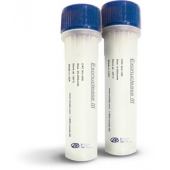
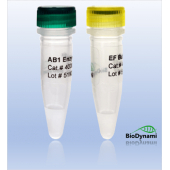
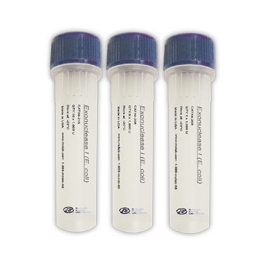
Exonuclease I cleaves single-stranded DNA in the 3' -> 5' direction, releasing 5'-mono/di-nucleotides and leaving double-stranded DNA molecules and the 5'-terminus intact. The enzyme is processed through digestion and is inhibited by the presence of a 3'-terminal phosphate. Exonuclease I is tolerant of a wide-range of buffer conditions and can typically be added to reactions containing magnesium(1-3).
Specific Activity: 185,000 U/mg
Application:
- Removal of residual ssDNA, including oligos, from reaction mixes
Source:
Purified from a strain of E. coli that expresses the recombinant Exonuclease I gene.
Supplied in:
10 mM Tris-HCl
100 mM NaCl
1 mM DTT
0.5 mM EDTA
50% Glycerol
pH 7.5 @ 25°C
10x Exonuclease I Buffer
670 mM Glycine-KOH
67 mM MgCl2
100 mM 2-mercaptoethanol
(pH9.5@25°C)
Unit Definition:
One unit is defined as the amount of enzyme required to produce 10 nmol of acid-soluble total nucleotide in 30 minutes at 37°C.
Recommended Storage Condition: -20°C
Reference:
1. Lehman, I.R. and Nussbaum, A.L. (1964) J. Biol. Chem. 239, 2628.
2. Kushner, S.R. et al. (1971) Proc. Natl. Acad. Sci. USA 68, 824.
3. Kushner, S.R. et al. (1972) Proc. Natl. Acad. Sci. USA 69, 1366.

PFS 5′-GAAAG-3′
Origin: Sulfuricurvum sp. PC08-66
Purity > 95%
Adaptive immune systems from prokaryotes utilize clustered regularly interspaced short palindromic repeats (CRISPRs) and CRISPR associated (Cas) proteins to cleave foreign genetic material. CasRx, Cas13d from Ruminococcus flavefaciens XPD3002, is highly active and short, 94KD.
Fast and simple fragmentation
Fragment size easily controlled by incubation time
Ideal for NGS library preparation
Cas9 Nuclease, Streptococcus pyogenes, is an RNA-guided endonuclease that catalyzes site-specific cleavage of double stranded DNA.
Adaptive immune systems from prokaryotes utilize clustered regularly interspaced short palindromic
repeats (CRISPRs) and CRISPR associated (Cas) proteins to cleave foreign genetic material. Cas13a, (previously referred to as C2c2) is part of the Type VI CRISPR-Cas system.
Adaptive immune systems from prokaryotes utilize clustered regularly interspaced short palindromic repeats (CRISPRs) and CRISPR associated (Cas) proteins to cleave foreign genetic material. Cas13a, (previously referred to as C2c2) is part of the Type VI CRISPR-Cas system.
Benzonase endonuclease from Serratia marcescens, can be used to degrade all forms of DNA and RNA while having no proteolytic activity.
origin: E. coli carrying the Tn5 gene
random transposon insertion into DNA
requires 19-bp ME sequence
Fast and simple fragmentation
Fragment size easily controlled by incubation time
Ideal for NGS library preparation
Adaptive immune systems from prokaryotes utilize clustered regularly interspaced short palindromic repeats (CRISPRs) and CRISPR associated (Cas) proteins to cleave foreign genetic material. CasRx, Cas13d from Ruminococcus flavefaciens XPD3002, is highly active and short, 94KD.