
 Čeština
 English
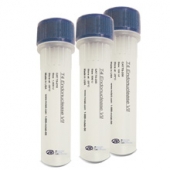
origin: E. coli carrying the Tn5 gene
random transposon insertion into DNA
requires 19-bp ME sequence
Description:
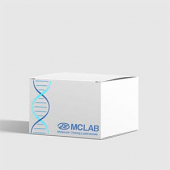
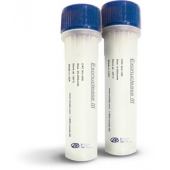
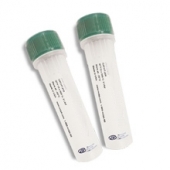
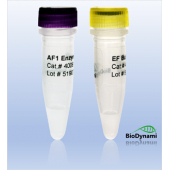
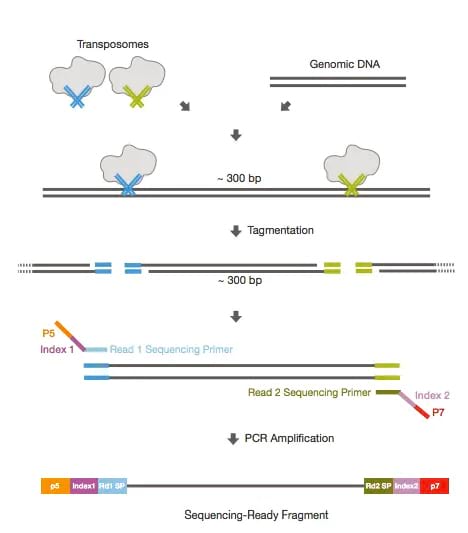
MCLAB’s Tn5 Transposase represents a highly active variant of the Tn5 transposase enzyme. This enzyme facilitates the random insertion of a Tn5 Transposon into target DNA in vitro. Efficient transposition requires the presence of a specific 19-bp transposase recognition sequence (Mosaic End or ME sequence) at each end of the Tn5 Transposon.
The transposition process catalyzed by the Tn5 Transposase involves a multi-step “cut and paste” mechanism. Initially, the enzyme binds to the 19-bp ME of the transposon, forming a complex known as the Transposome. Subsequently, the Transposome initiates random attacks on the phosphodiester backbone of the target DNA, leading to cleavage. Finally, the Tn5 Transposase catalyzes the covalent linkage of the 3′-OH ends of the transposon to the exposed 5′-phosphorylated ends of the target DNA. This transposition event results in the creation of a 9-bp sequence duplication immediately flanking the site of transposon insertion.
Enzyme is supplied at a concentration of 1 U/µL.
Application:
Purified from an E. coli strain carrying the Tn5 gene.
-20°C, avoid repeated free-thaw
10X Tn5 Transposase Reaction Buffer (1 M Tris-acetate (pH 7.5); 3 M potassium acetate; 200 mM magnesium acetate)
10X Tn5 Stop Solution (1% SDS)
100 µL (cat.n. TN5-100)
500 µL (cat.n. TN5-200)

Adaptive immune systems from prokaryotes utilize clustered regularly interspaced short palindromic repeats (CRISPRs) and CRISPR associated (Cas) proteins to cleave foreign genetic material. CasRx, Cas13d from Ruminococcus flavefaciens XPD3002, is highly active and short, 94KD.
PFS 5′-GAAAG-3′
Origin: Sulfuricurvum sp. PC08-66
Purity > 95%
Adaptive immune systems from prokaryotes utilize clustered regularly interspaced short palindromic repeats (CRISPRs) and CRISPR associated (Cas) proteins to cleave foreign genetic material. Cas13a, (previously referred to as C2c2) is part of the Type VI CRISPR-Cas system.
Adaptive immune systems from prokaryotes utilize clustered regularly interspaced short palindromic repeats (CRISPRs) and CRISPR associated (Cas) proteins to cleave foreign genetic material. CasRx, Cas13d from Ruminococcus flavefaciens XPD3002, is highly active and short, 94KD.
Cas9 Nuclease, Streptococcus pyogenes, is an RNA-guided endonuclease that catalyzes site-specific cleavage of double stranded DNA.
Benzonase endonuclease from Serratia marcescens, can be used to degrade all forms of DNA and RNA while having no proteolytic activity.
Fast and simple fragmentation
Fragment size easily controlled by incubation time
Ideal for NGS library preparation
CRISPR-Cas systems are powerful tools for mediating nucleic acids. Cas12a (also referred as Cpf1) nuclease belonging to the Class 2, Type V CRISPR system.
Adaptive immune systems from prokaryotes utilize clustered regularly interspaced short palindromic
repeats (CRISPRs) and CRISPR associated (Cas) proteins to cleave foreign genetic material. Cas13a, (previously referred to as C2c2) is part of the Type VI CRISPR-Cas system.
Fast and simple fragmentation
Fragment size easily controlled by incubation time
Ideal for NGS library preparation
Fast and simple fragmentation
Fragment size easily controlled by incubation time
Ideal for NGS library preparation
origin: E. coli carrying the Tn5 gene
random transposon insertion into DNA
requires 19-bp ME sequence