
 Čeština
 English
Description:
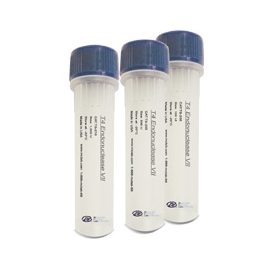
Endonuclease VII is the product of gene 49 of bacteriophage T4. It has a mass of 18 kDa. T4 Endonuclease VII involves in DNA-packaging, genetic recombination and mismatch repair in vivo. It has also been demonstrated in vitro to resolve single-base misparings, heteroduplex loops and branched DNAs, such as four-way Holliday junctions and three-way Y-structures.

Source:
A recombinant E. coli strain carrying the cloned T4 Endonuclease VII gene
Unit Definition:
One unit (0.5 ng) of the enzyme resolves 50% of 1 pmol FAM labeled 28mer oligonucleotide substrate [1] within the immobile 4-way Holliday junction structure in 30 minutes at 37°C in 50mM Tris-HCl, pH 8.0, 10mM MgCl2, 10mM 2-ME and 0.1 μg/μl BSA.
Specific Activity: 2000 U/µg
Recommended Storage Condition: -20°C
Experimental Data:

Figure1. Performance of MCLAB’s T4 Endonuclease VII analyzed by capillary electrophoresis. (a) Negative control sample analysis, 10 pmol of FAM labeled 28mer oligonucleotide substrate. (b) 40 U of MCLAB’s T4 Endonuclease VII was able to fully resolve 10 pmol of FAM labeled 28mer oligonucleotide substrate with a 4-way Holliday junction structure (30 minutes at 37°C in 50 mM Tris-HCl, pH 8.0, 10 mM MgCl2, 10 mM 2-ME and 0.1 μg/μl BSA). 
Figure2. MCLAB’s T4 Endonuclease VII and T7 Endonuclease I (from other supplier) activity comparison. (a) 10 U (275 fmol) of MCLAB T4’s Endonuclease VII can resolve 64% of 10 pmol of 4-way junction substrate (enzyme to substrate molar ratio 1:70) in 30 minutes at 37°C in 50 mM Tris-HCl, pH 8.0, 10 mM MgCl2, 10 mM 2-ME and 0.1 μg/μl BSA. (b) 40 U (368 fmol) of T7 Endonuclease I (supplier N) only resolves 43% of 10 pmol of 4-way junction substrate (enzyme to substrate molar ratio 1:50) in 30 minutes at 37°C in 50 mM NaCl, 10 mM Tris-HCl, pH 7.9, 10 mM MgCl2, 1 mM DTT. Compared to T7 Endonuclease I (supplier N), MCLAB’s T4 Endonuclease VII resolves 4-way Holliday Junctions at a higher yield in 30 minutes with less enzyme.
Table. Comparison of T4 Endonuclease VII and T7 Endonuclease I
|
|
T4 Endonuclease VII |
T7 Endonuclease I |
|
Protein Mass |
18 KDa |
60 kDa |
|
Function |
Resolvase |
Resolvase |
|
Application |
Enzymatic mutation detection |
Enzymatic mutation detection |
|
Source |
Bacteriophage T4 |
Bacteriophage T7 |
|
Protein Design |
T4 Endonuclease VII |
A fusion of maltose binding protein (MBP) and T7 Endonuclease I |
|
Activity |
High* |
Low* |
|
Specificity |
High* (single resolved peak shown on CE) |
Low* (multiple resolved peaks shown on CE) |
* See Figure 2 for T4 endonuclease VII and T7 endonuclease I activity comparison result.
Supplied in:
10 mM Tris-HCl
50 mM KCl
1 mM DTT
0.1 mM EDTA
50% Glycerol
pH 7.4 @ 25°C
Supplied With:
10x T4 Endonuclease VII Reaction Buffer:
500 mM Tris-HCl
100 mM MgCl2
100 mM 2-mercaptoethanol
1 mg/ml BSA
pH 8.0 @ 25°C
Reference:
1. Golz, S., Birkenbihl, R. P., and Kemper, B. (1995), DNA Research 2, 277-284.

Benzonase endonuclease from Serratia marcescens, can be used to degrade all forms of DNA and RNA while having no proteolytic activity.
Adaptive immune systems from prokaryotes utilize clustered regularly interspaced short palindromic repeats (CRISPRs) and CRISPR associated (Cas) proteins to cleave foreign genetic material. Cas13a, (previously referred to as C2c2) is part of the Type VI CRISPR-Cas system.
Cas9 Nuclease, Streptococcus pyogenes, is an RNA-guided endonuclease that catalyzes site-specific cleavage of double stranded DNA.
origin: E. coli carrying the Tn5 gene
random transposon insertion into DNA
requires 19-bp ME sequence
Fast and simple fragmentation
Fragment size easily controlled by incubation time
Ideal for NGS library preparation
CRISPR-Cas systems are powerful tools for mediating nucleic acids. Cas12a (also referred as Cpf1) nuclease belonging to the Class 2, Type V CRISPR system.
Adaptive immune systems from prokaryotes utilize clustered regularly interspaced short palindromic
repeats (CRISPRs) and CRISPR associated (Cas) proteins to cleave foreign genetic material. Cas13a, (previously referred to as C2c2) is part of the Type VI CRISPR-Cas system.
Adaptive immune systems from prokaryotes utilize clustered regularly interspaced short palindromic repeats (CRISPRs) and CRISPR associated (Cas) proteins to cleave foreign genetic material. CasRx, Cas13d from Ruminococcus flavefaciens XPD3002, is highly active and short, 94KD.
Fast and simple fragmentation
Fragment size easily controlled by incubation time
Ideal for NGS library preparation
Adaptive immune systems from prokaryotes utilize clustered regularly interspaced short palindromic repeats (CRISPRs) and CRISPR associated (Cas) proteins to cleave foreign genetic material. CasRx, Cas13d from Ruminococcus flavefaciens XPD3002, is highly active and short, 94KD.
Fast and simple fragmentation
Fragment size easily controlled by incubation time
Ideal for NGS library preparation