
 Čeština
 Polski

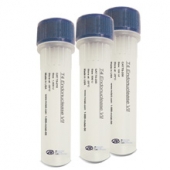
The MutS DNA mismatch protein recognizes heteroduplex DNAs containing mispaired or unpaired bases.
Description
The MutS DNA mismatch protein recognizes heteroduplex DNAs containing mispaired or unpaired bases. This Muts protein binds in vitro to heteroduplex DNAs containing mispaired or unpaired bases over a wide temperature range from 4 to 70 °C and has a thermostable ATPase activity. This thermostable Taq MutS is active at temperature between 0 to 75°C. Since Taq MutS efficiently binds to 1-4 bases deletion (or insertion) and mismatch base pairs of GT, CT and AG, it is useful for detecting these mutations. Mutations can be detected in polyacrylamide gels or on a solid phase such as Ni agarose or beads or magnetic Ni-NTA particles.
Applications
Remove mismatch DNA (error correction) from gene synthesis reaction
Mutation detection and removal
Rapid isothermal SNP detection
Full name
Thermus aquaticus MutS DNA mismatch repair protein
Source
E. coli
Fusion Tag
6XHis tag at C-terminus
Accession #
AAC43637
Molecule Weight
92.8 kDa
Purity
> 98 % as determined by SDS-PAGE
Storage Buffer
20 mM Tris-HCl, pH 8.0, 250 mM NaCl, 0.1mM EDTA, 1 mM DTT, 50% Glycerol
Reaction Buffer
100mM KCl, 50 mM Tris-HCl, pH 8.5, 10 mM MgCl2, 0.1 mM EDTA, 1 mM DTT, 2% Glycerol, 65 °C
Storage
-20°C Avoid repeated freeze-thaw cycles.
Endonuclease III (Nth) protein from E. coli acts as both N-glycosylase and a AP-lyase. The N-glycosylase activity releases damaged pyrimidines from double-stranded DNA, generating a basic (AP site).
Endonuclease VIII from E. coli acts as both an N-glycosylase and an AP-lyase. The N-glycosylase activity releases damaged pyrimidines from double-stranded DNA, generating an apurinic (AP site).
Human Recombinant Alkyl Adenine DNA Glycosylase produced in E.Coli is a single, non-glycosylated polypeptide chain containing 306 amino acids (1-298 a.a.) and having a molecular mass of 33.9kDa (Molecular weight on SDS-PAGE will appear higher).
Endonuclease V, (Endo V) is a 3'-endonuclease involved in DNA repair, which initiates removal of deaminated bases from damaged DNA, including uracil, hypoxanthine, and xanthine.
Endonuclease V, (Endo V) is a 3'-endonuclease involved in DNA repair, which initiates removal of deaminated bases from damaged DNA, including uracil, hypoxanthine, and xanthine.
Human Trypsin 1, encoded by the PRSS1 gene, is also known as cationic trypsinogen. It contains a signal peptide (residues 1‑15), a pro region (residues 16‑23), and a mature chain (residues 24‑247).
The MutS DNA mismatch protein recognizes heteroduplex DNAs containing mispaired or unpaired bases.