
 Čeština
 Polski
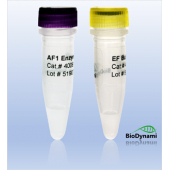
Description:
Fpg (also known as Formamidopyrimidine DNA glycosylase, Mut M, FAPY DNA Glycosylase, and 8-oxoguanine DNA glycosylase) participates in the base-excision (BER) pathway of DNA repair enzymes and acts both as a N-glycosylase and an AP-lyase. The N-glycosylase activity releases damaged purines from double stranded DNA, generating an apurinic/apyrimidinic (AP site). The AP-lyase activity cleaves both the 3′ and 5′ phosphodiester bonds at the AP site, producing a 1 base gap in the DNA and 3′ and 5′ phosphate termini. Bases recognized and removed by Fpg include 7, 8-dihydro-8-oxoguanine (8-oxoguanine), 8-oxoadenine, fapy-guanine, methy-fapy-guanine, fapy-adenine, aflatoxin B1-fapy-guanine, 5-hydroxy-cytosine and 5-hydroxy-uracil
Application:
- DNA Nicking
- DNA Repair
- Nick Translation
Source:
A recombinant E. coli strain carrying the cloned fpg gene.
Specific Activity: 20,513 U/mg
Supplied With:
10X Fpg Buffer
Incubate at 37°C
10X Fpg Buffer:
100 mM Bis-Tris-Propane
100 mM MgCl2
10 mM DTT
1 mg/ml BSA
pH 7.0 @ 25°C
Supplied in:
20 mM Tris-HCl
50 mM NaCl
1.0 mM DTT
0.1 mM EDTA
50% glycerol
pH 8.0 @ 25°C
Unit Definition:
One unit is defined as the amount of enzyme required to cleave 1 pmol of a 34mer oligo-nucleotide duplex containing an 8-oxoguanine base paired with a cytosine in 1 hour at 37°C in a total reaction volume of 10µl in reaction buffer.
Recommended Storage Condition: -20°C
Fast and simple fragmentation
Fragment size easily controlled by incubation time
Ideal for NGS library preparation
Fast and simple fragmentation
Fragment size easily controlled by incubation time
Ideal for NGS library preparation
High efficiency
Low GC bias
Input DNA: 500 pg to 1 µg
Fast and easy ligation
High efficiency
Optimized formulation
Fast and simple fragmentation
Fragment size easily controlled by incubation time
Ideal for NGS library preparation