
 Čeština
 Polski
Description:
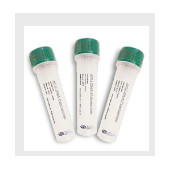
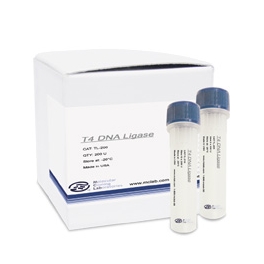
T4 DNA Ligase catalyzes the formation of a phosphodiester bond between juxtaposed 5'-phosphate and 3'-hydroxyl termini in duplex DNA or RNA using ATP as a cofactor.
Figure. Ligation of λ DNA/Hind III fragments analyzed by agarose gel electrophoresis.
Performances of T4 DNA ligase from MCLAB and another supplier were compared within identical reaction mixture at 37°C for 30 minutes. Paralleled negative control was run without ligase.
Application:
- Cloning of restriction fragments
- Joining linkers and adapters to blunt-ended DNA
Source:
A recombinant E. coli strain carrying the cloned T4 DNA Ligase gene.
Supplied In:
10 mM Tris-HCl
50 mM KCl
1 mM DTT
0.1 mM EDTA
50% Glycerol
pH 7.4 @ 25°C
Supplied With:
10x T4 DNA Ligase Buffer
500mM Tris-HCl
100 mM MgCl2
50 mM DTT
10 mM ATP
pH 7.6 @ 25°C
Unit Definition:
One Weiss unit of the enzyme catalyzes the conversion of 1 nmol of [32PPi] into Norit-adsorbable form in 20 min at 37°C. Enzyme activity is assayed in the following mixture: 66 mM Tris-HCl (pH 7.6), 6.6 mM MgCl2, 0.066 mM ATP, 10 mM DTT, 3.3 µM [32PPi].
One Weiss Unit is approximately equivalent to 67 cohesive end units (CEU). Or 1000 CEU = 15 Weiss Unit.
Specific Activity: 300U/µg
Recommended Storage Condition: -20°C
Fast and easy ligation
High efficiency
Optimized formulation
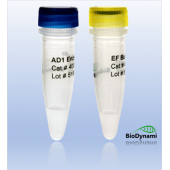
Fast and simple fragmentation
Fragment size easily controlled by incubation time
Ideal for NGS library preparation
High efficiency
Low GC bias
Input DNA: 500 pg to 1 µg
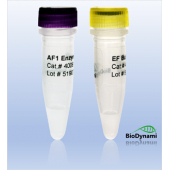
Fast and simple fragmentation
Fragment size easily controlled by incubation time
Ideal for NGS library preparation
Fast and simple fragmentation
Fragment size easily controlled by incubation time
Ideal for NGS library preparation