
 Čeština
 Polski
Fast and simple fragmentation
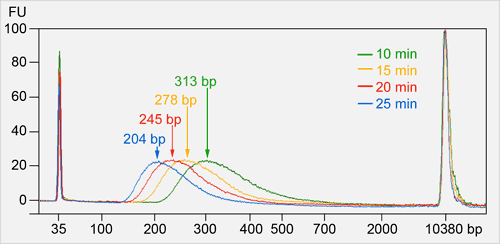
Fragment size easily controlled by incubation time
Ideal for NGS library preparation
Description:
The enzyme mix was developed to generate random fragmentation of genomic DNA with blunt ends in a single step. The fragmented DNA can be used for applications such as Next-Generation Sequencing (NGS), blunt end ligation and PCR cloning.
Compared to mechanical shearing methods, enzymatic DNA fragmentation is significantly easier and more efficient. It allows convenient handling of multiple samples simultaneously, minimizes sample loss, and eliminates the need for expensive equipment.
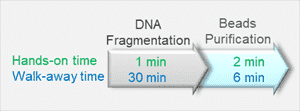
The illustration below shows the workflow for DNA fragmentation for NGS:
Step 1: DNA fragmentation – 1 minute hands-on, 30 minutes incubation
Step 2: Magnetic bead purification – 2 minutes hands-on, 6 minutes automated incubation
This streamlined process saves time, allowing most of the workflow to run unattended.
The graph demonstrates how DNA fragmentation progresses depending on incubation time using this enzymatic mix. Each curve represents a different incubation duration (10, 15, 20, 25 minutes) and the resulting average DNA fragment sizes (204–313 bp). The product allows precise control over fragment size – longer incubation yields smaller DNA fragments.
Features:
Product sizes:
50 reactions (Cat. No. 40063S)
200 reactions (Cat. No. 40063L)
Benzonase endonuclease from Serratia marcescens, can be used to degrade all forms of DNA and RNA while having no proteolytic activity.
Cas9 Nuclease, Streptococcus pyogenes, is an RNA-guided endonuclease that catalyzes site-specific cleavage of double stranded DNA.
Fast and simple fragmentation
Fragment size easily controlled by incubation time
Ideal for NGS library preparation
Adaptive immune systems from prokaryotes utilize clustered regularly interspaced short palindromic repeats (CRISPRs) and CRISPR associated (Cas) proteins to cleave foreign genetic material. CasRx, Cas13d from Ruminococcus flavefaciens XPD3002, is highly active and short, 94KD.
PFS 5′-GAAAG-3′
Origin: Sulfuricurvum sp. PC08-66
Purity > 95%
CRISPR-Cas systems are powerful tools for mediating nucleic acids. Cas12a (also referred as Cpf1) nuclease belonging to the Class 2, Type V CRISPR system.
Adaptive immune systems from prokaryotes utilize clustered regularly interspaced short palindromic repeats (CRISPRs) and CRISPR associated (Cas) proteins to cleave foreign genetic material. Cas13a, (previously referred to as C2c2) is part of the Type VI CRISPR-Cas system.
LE-100 5,000 units, 20,000 U/ml 120 €
LE-200 20,000 units 20,000 U/ml 361 €
|
|
|
|
Adaptive immune systems from prokaryotes utilize clustered regularly interspaced short palindromic repeats (CRISPRs) and CRISPR associated (Cas) proteins to cleave foreign genetic material. CasRx, Cas13d from Ruminococcus flavefaciens XPD3002, is highly active and short, 94KD.
Adaptive immune systems from prokaryotes utilize clustered regularly interspaced short palindromic
repeats (CRISPRs) and CRISPR associated (Cas) proteins to cleave foreign genetic material. Cas13a, (previously referred to as C2c2) is part of the Type VI CRISPR-Cas system.
Fast and simple fragmentation
Fragment size easily controlled by incubation time
Ideal for NGS library preparation