
 Čeština
 Polski
- New

cfDNA and cfRNA
From plasma and serum
Elution from 10 µL
Description:
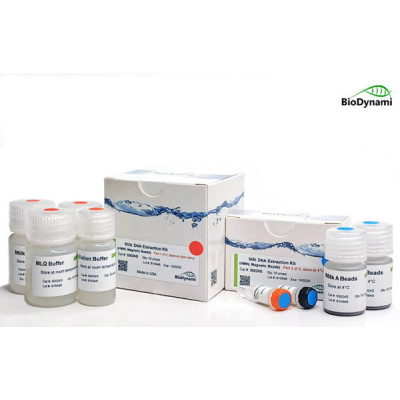
Plasma/Serum Cell-free DNA/RNA Extraction Kit (Magnetic Beads) is a kit for efficient isolation of cell-free DNA (cfDNA) and cell-free RNA (cfRNA) from fresh or frozen plasma and serum samples. The analysis of cfDNA and cfRNA in these biofluids serves as a non-invasive biomarker, particularly in oncology. These nucleic acid fragments are released into the bloodstream during normal physiological processes such as apoptosis, as well as from necrotic cancer cells. cfDNA fragments are typically short, averaging around 170 base pairs (bp), which corresponds to the length of DNA wrapped around a mononucleosome. The fragmentation pattern of DNA in circulation can be influenced by various pathological conditions, including cancer development, infection, immune reactions and inflammation. The kit uses proprietary magnetic bead technology optimized for the superior recovery of minute quantities of cfDNA and cfRNA from cell-free fluids. The streamlined protocol eliminates the need for time-consuming centrifugation or vacuum steps and purified fragments can be eluted in volumes as low as 10 µL, maximizing concentration for sensitive downstream assays. The extracted cfDNA and cfRNA are suitable for a wide range of demanding applications, including next-generation sequencing (NGS), bisulfite sequencing, PCR and qPCR.
The image shows an electrophoretic gel-like trace of DNA extracted from plasma (samples A and B). On the left is a size marker ranging from 35 bp to 10,380 bp (bands at 100, 150, 200, 300, 400, 500, 600, 700, 1000, 2000, 3000, 7000 and 10,380 bp); the upper and lower edges of the trace are marked with a purple (10,380 bp) and a green (35 bp) reference band. In sample A, the most prominent signal is around 170 bp, between the 150 and 200 bp marker bands, which corresponds to the typical size of cfDNA. In addition, a weaker band of long DNA is visible at the upper edge. In sample B, there is a distinct band around 150 bp and above it a broad smeared signal extending approximately from 2000 bp up to the upper limit of the trace.

Features:
Applications:
Workflow:
Plasma Beads and Proteinase K are added to 1 mL of plasma or serum sample in a 15 mL tube and the mixture is incubated for 40 minutes at 56 °C. The tubes are placed on a magnet, where the beads are captured and the supernatant is removed. The beads are washed with GSO Buffer and 80% isopropanol and, after transfer to a new microtube, PRE Buffer and SPT Buffer are added, which bind the DNA and RNA to the beads again. Two washes with 80% ethanol and a brief drying of the beads follow. Finally, the nucleic acids are released from the beads into the elution solution (10–40 µL) and, after magnetic separation, the supernatant is transferred to a new tube. The protocol has three variants: A for combined DNA and RNA isolation, B for DNA-only isolation, where RNase A is added to the lysate, and C for RNA-only isolation, where DNase I digestion is performed after the beads are dried.

Kit contents:
Equipment and reagents required but not included: magnetic particle concentrator, vortexer, heat block, incubator or water bath, 96-well plates or 96-deep well plates, microfuge tubes, 15 mL tubes, 80% isopropanol and 80% ethanol (prepare before use), RNase A (if only DNA is isolated), DNase I (if only RNA is isolated).
Specification:
| Parameter | Value |
|---|---|
| Technology | magnetic beads |
| Sample type | fresh or frozen plasma or serum |
| Sample volume | 1 mL |
| Typical yield | 0.5–20 ng from healthy donors |
| Fragment sizes | from 100 bp to > 10 kb (genomic DNA and RNA) |
| Elution volume | as low as 10 µL (protocol states 10–40 µL) |
| Elution solution | elution buffer (10 mM Tris, pH 8.0), TE, low TE or water (for the variant without RNase) |
| Purity | cfDNA/RNA is NGS and PCR ready, typical A260/A280 around 1.8 |
Purification of tRNA and oligos (>70 nt)
Removal of RNA/DNA contamination
Efficiency approximately 83%
DNA from milk
Centrifuge-free
Including mastitic milk
dynamic range
without fluorescent quantification
no centrifugation and filtration
with recovery beads
Purification of PCR fragments >80 bp
Removal of primers <30 nt
Manual/automated processing
DNA and RNA concentrator
Binding capacity: 10 µg DNA per prep
Removal of unwanted components
Disposable set
Tissue homogenization
RNase- and DNase-free
miRNA purification
Efficiency up to 80%
Removal of tRNA, 5S RNA
cfDNA from urine
5 mL sample
Elution from 10 µL
gDNA purification
95% efficiency
removal of RNA
dynamic range
without fluorescent quantification
no centrifugation and filtration
without recovery beads
purification of short DNA/RNA fragments
removal of impurities
for manual/automated procedure
DNA isolation from 100 bases
RNA isolation from 200 bases
Elution volume from 10 µl
cfDNA 50–500 bp
90% yield
compatible with automated systems
DNA removal
RNA purification
Magnetic beads
Disposable pestle
Tissue homogenization
RNase- and DNase-free
RNA removal
RNase A free
Magnetic beads
cfDNA from urine
5 mL sample
Elution from 10 µL
Total RNA from bacteria
No phenol, no chloroform
No DNase treatment
Plasmid DNA
96-well plates
From 0.2 mL culture
Disposable pestle
Tissue homogenization
RNase- and DNase-free
cfDNA and cfRNA
From plasma and serum
Elution from 10 µL