
 Čeština
 Polski
cfDNA 50–500 bp
90% yield
compatible with automated systems
Description:
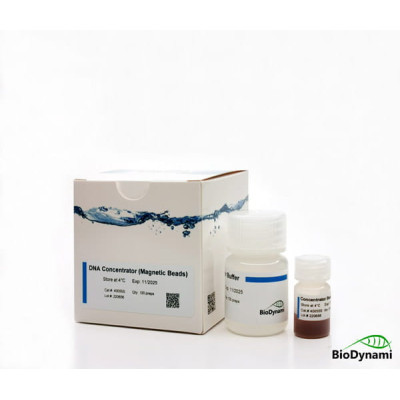
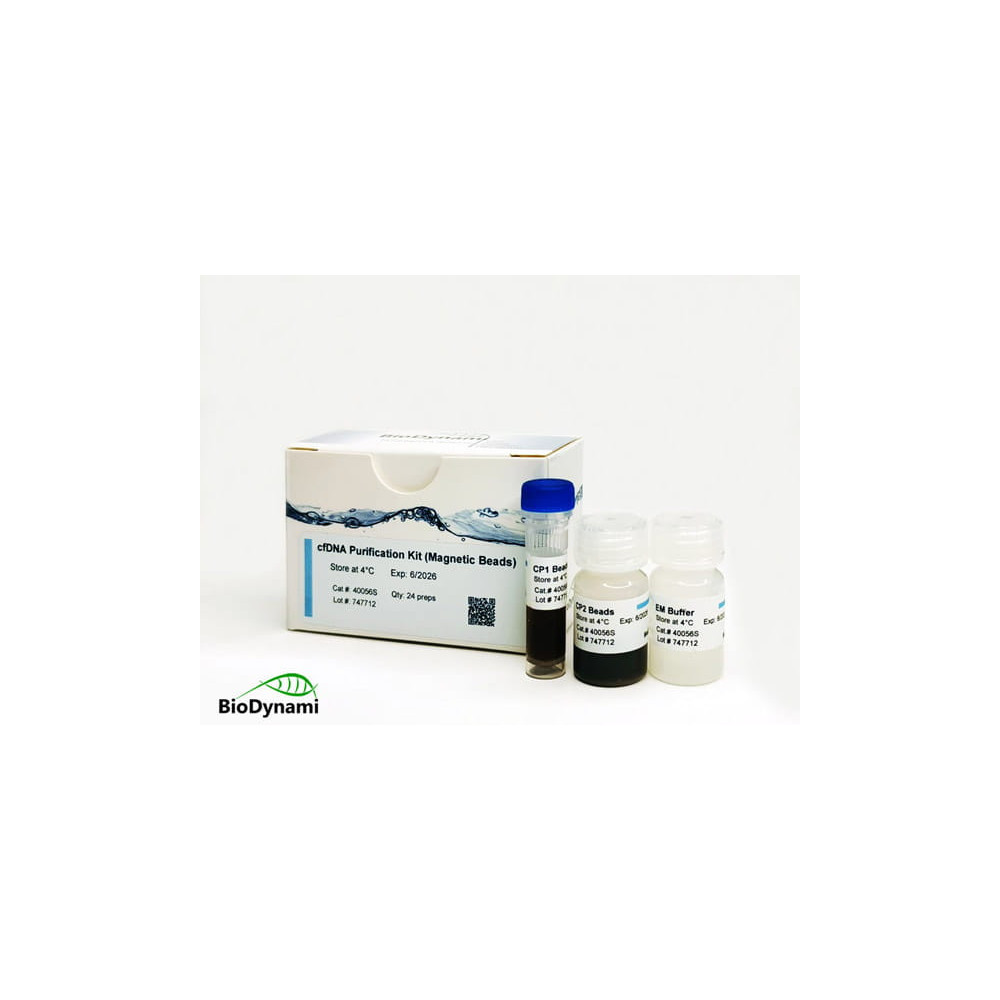
The cfDNA Purification Kit from the American company BioDynami utilizes magnetic beads for efficient purification and enrichment of cell-free DNA (cfDNA) from liquid biopsy samples such as plasma, serum, urine, and cerebrospinal fluid. It is designed to separate cfDNA from contaminating genomic DNA, leading to improved results in downstream applications.
cfDNA plays a crucial role in diagnosing various diseases, particularly in detecting cancer-related signals. Common DNA isolation methods from plasma often yield variable results with genomic DNA contamination, which can affect the sensitivity and consistency of subsequent analyses such as next-generation sequencing (NGS), PCR, and digital PCR.
This kit enables the specific recovery of cfDNA fragments (50-500 bp) while removing high-molecular-weight genomic DNA. This is especially important as cfDNA fragments derived from cancer cells are often under 100 bp and difficult to detect using standard methods. Enriching cfDNA before further processing can significantly enhance the detection of tumor-derived signals.
The kit utilizes Dual Solid Phase Reversible Immobilization (SPRI) technology for cfDNA purification. It allows recovery of over 90% cfDNA without genomic DNA contamination. Fragments larger than 500 bp can also be recovered. Both DNA fractions (50-500 bp and >500 bp) are suitable for applications such as NGS library preparation (single-stranded and double-stranded), qPCR, ddPCR, and other molecular biology methods.
Workflow:
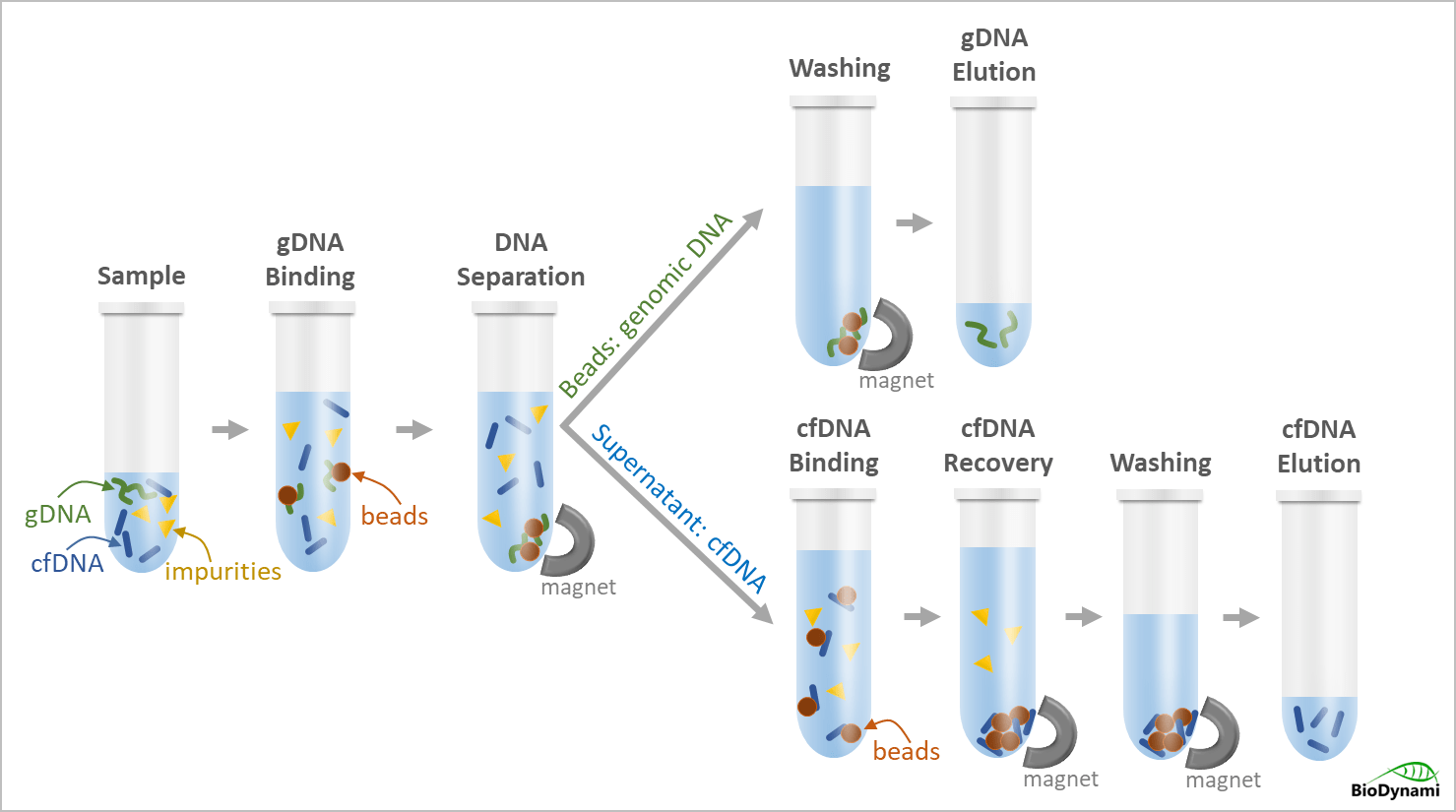
A schematic representation of the cfDNA purification process using magnetic beads is shown below. The first step involves selectively binding genomic DNA to magnetic beads, which are then separated from the solution containing cfDNA and other impurities using a magnet. The supernatant containing cfDNA is carefully collected, and the beads with genomic DNA are washed and eluted to obtain pure genomic DNA. In the next step, new magnetic beads are added to the supernatant to bind cfDNA. The beads with bound cfDNA are then washed and eluted, yielding high-quality purified cfDNA suitable for further molecular biological analyses. This process ensures efficient separation of cfDNA from genomic DNA and other unwanted components.
Efficiency:
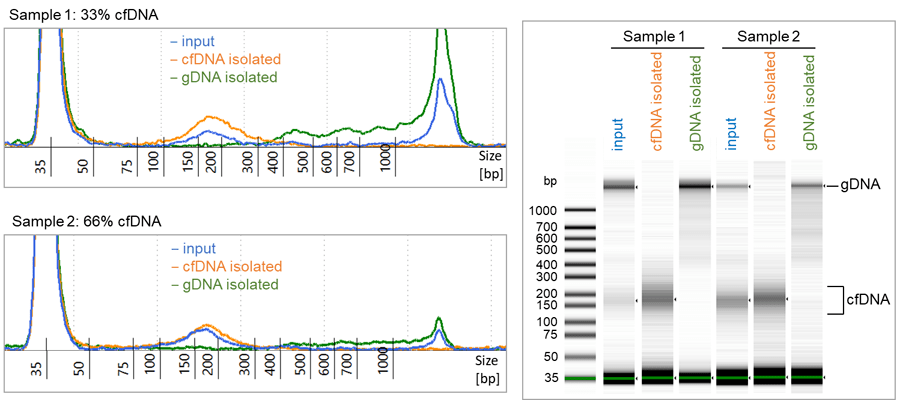
The efficiency of cfDNA isolation using magnetic beads is demonstrated in the graphs. The graphs on the left show that purification leads to enrichment of short cfDNA fragments (35-100 bp) and removal of large gDNA fragments, visible in two samples with different cfDNA content. Gel electrophoresis confirms effective separation of cfDNA and gDNA fractions after purification, demonstrating the selectivity of the method.
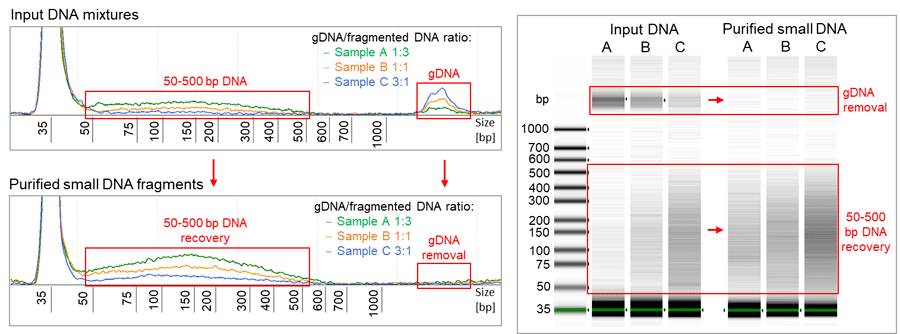
The efficiency of purifying small DNA fragments (50-500 bp) and selectively separating them from genomic DNA (gDNA) using magnetic beads is shown below. The graphs and gel electrophoresis confirm that purification results in the enrichment of target DNA fragments (50-500 bp) while effectively removing gDNA. Different samples with varying ratios of gDNA and fragmented DNA demonstrate the robustness of the method.
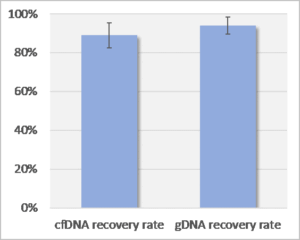
The method enables high recovery rates for both cfDNA and gDNA, with a recovery rate close to 90% or more. This indicates high efficiency and minimal DNA loss during the purification process.
Features:

plasmid purification
removal of RNA
DNA isolation from 100 bases
RNA isolation from 200 bases
Elution volume from 10 µl
DNA from milk
Centrifuge-free
Including mastitic milk
Purification of PCR fragments >80 bp
Removal of primers <30 nt
Manual/automated processing
DNA and RNA concentrator
Binding capacity: 10 µg DNA per prep
Removal of unwanted components
DNA removal
RNA purification
Magnetic beads
Disposable set
Tissue homogenization
RNase- and DNase-free
gDNA purification
95% efficiency
removal of RNA
cfDNA from urine
5 mL sample
Elution from 10 µL
oligo purification > 6 nt
impurity removal
DNA and RNA compatibility
Purification of tRNA and oligos (>70 nt)
Removal of RNA/DNA contamination
Efficiency approximately 83%
cfDNA and cfRNA
From plasma and serum
Elution from 10 µL
dynamic range
without fluorescent quantification
no centrifugation and filtration
without recovery beads
RNA removal
RNase A free
Magnetic beads
dynamic range
without fluorescent quantification
no centrifugation and filtration
with recovery beads
Disposable pestle
Tissue homogenization
RNase- and DNase-free
Purification of tRNA and oligos (>70 nt)
Removal of RNA/DNA contamination
Efficiency approximately 83%
cfDNA 50–500 bp
90% yield
compatible with automated systems