
 Čeština
 Polski
PFS 5′-GAAAG-3′
Origin: Sulfuricurvum sp. PC08-66
Purity > 95%
Description:
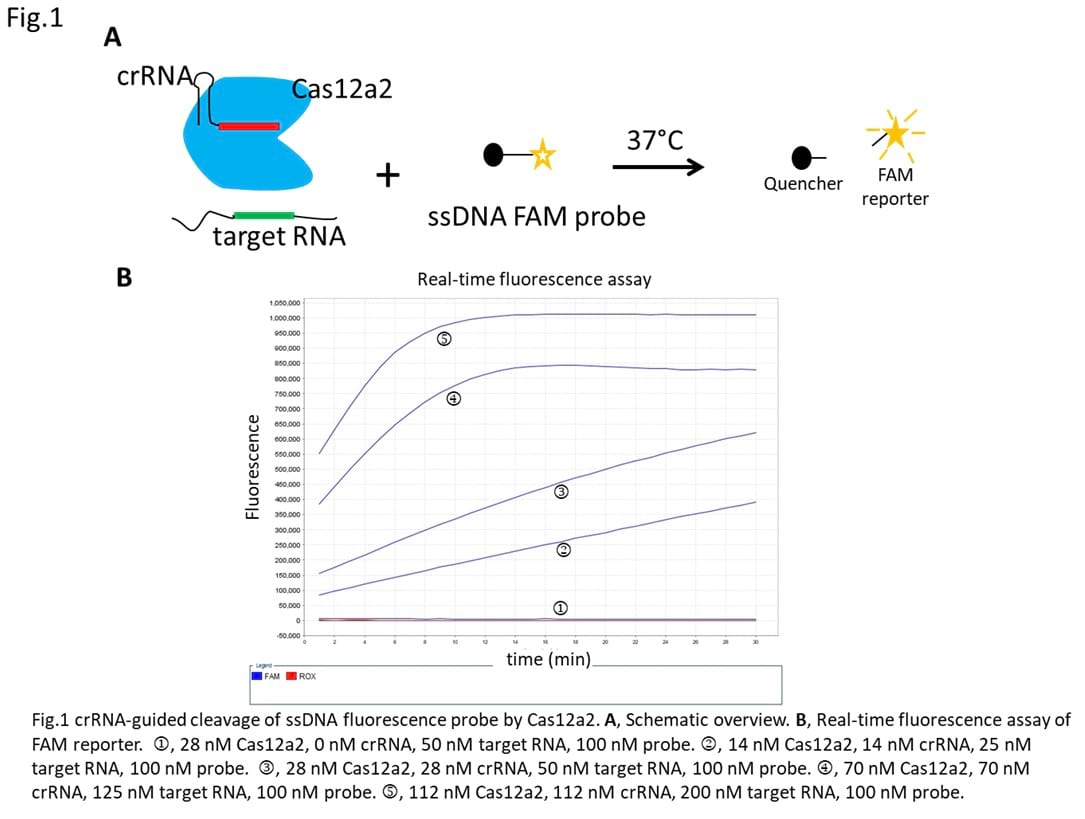
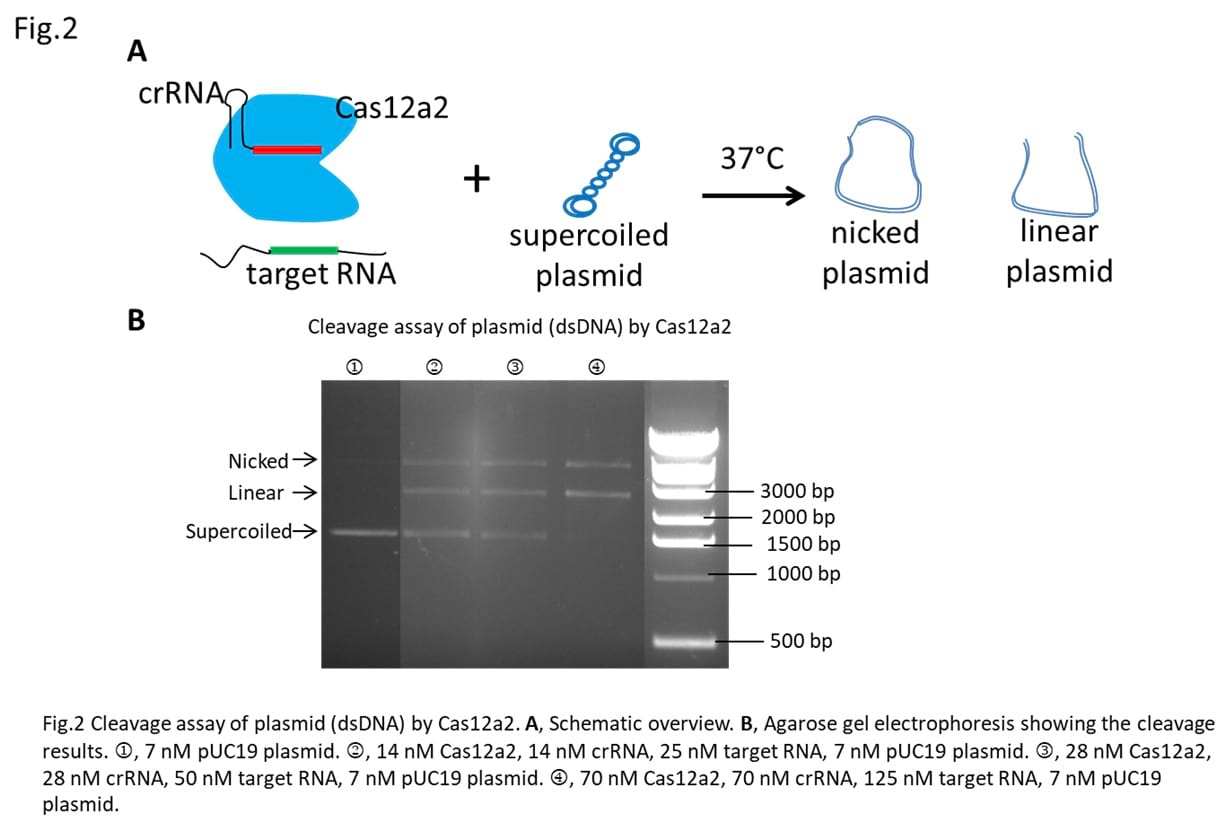
Cas12a2, a Type V CRISPR/Cas nuclease, cleaves the target RNA following target RNA recognition by the complementary crRNA. Cas12a2 processes its own crRNAs. The PFS requirement for Cas12a2 is 5′-GAAAG-3′. Cas12a2 can indiscriminately degrade single-stranded DNA (ssDNA), double-stranded DNA (dsDNA), and single -stranded RNA (ssRNA) as collateral activities once sensing correct crRNA-guided RNA binding. These properties enable Cas12a2 as a single-effector nuclease efficiently and sensitively for RNA detection. SuCas12a2 from Sulfuricurvum sp. PC08-66 is a programmable nuclease guided by a 42-44 nt crRNA and can be applied in RNA detection and genome editing.
The enzyme's purity is greater than 95%, as determined by SDS-PAGE and FPLC.
Activity: For the cleavage assay: 20 µl reaction, including SuCas12a2 Enzyme, crRNA, target RNA and 1x reaction buffer, preheated at 37°C for 15 min. Then for the ssDNA probe cleavage assay as Fig.1 below, added 100 nM ssDNA 5’FAM probe, incubated at 37°C for 30 min; For the plasmid cleavage assay as Fig. 2 below, added 7 nM pUC19 plasmid, incubated at 37°C for 25 min, and stop reaction with 1 µl Proteinase K (800 U/ml).
Application:
Source:
Cas12a2 gene from Sulfuricurvum sp. PC08-66 (SuCas12a2, UniProtKB: A0A0C2W1L1) expressed in E. coli.
Storage:
-20°C
Size:
200 pmol, 200 µl (1 µM) (cat.n. Cas12a2-100)
1 nmol, 200 µl (5 µM) (cat.n. Cas12a2-200)
10X Cas12a2 Reaction Buffer 200 µl (cat.n. CAS12A-BUF-100-A2)
10X Cas12a2 Reaction Buffer 1 ml (cat.n. CAS12A-BUF-200-A2)

LE-100 5,000 units, 20,000 U/ml 120 €
LE-200 20,000 units 20,000 U/ml 361 €
|
|
|
|
Fast and simple fragmentation
Fragment size easily controlled by incubation time
Ideal for NGS library preparation
Adaptive immune systems from prokaryotes utilize clustered regularly interspaced short palindromic repeats (CRISPRs) and CRISPR associated (Cas) proteins to cleave foreign genetic material. Cas13a, (previously referred to as C2c2) is part of the Type VI CRISPR-Cas system.
Adaptive immune systems from prokaryotes utilize clustered regularly interspaced short palindromic
repeats (CRISPRs) and CRISPR associated (Cas) proteins to cleave foreign genetic material. Cas13a, (previously referred to as C2c2) is part of the Type VI CRISPR-Cas system.
Benzonase endonuclease from Serratia marcescens, can be used to degrade all forms of DNA and RNA while having no proteolytic activity.
Cas9 Nuclease, Streptococcus pyogenes, is an RNA-guided endonuclease that catalyzes site-specific cleavage of double stranded DNA.
Adaptive immune systems from prokaryotes utilize clustered regularly interspaced short palindromic repeats (CRISPRs) and CRISPR associated (Cas) proteins to cleave foreign genetic material. CasRx, Cas13d from Ruminococcus flavefaciens XPD3002, is highly active and short, 94KD.
Adaptive immune systems from prokaryotes utilize clustered regularly interspaced short palindromic repeats (CRISPRs) and CRISPR associated (Cas) proteins to cleave foreign genetic material. CasRx, Cas13d from Ruminococcus flavefaciens XPD3002, is highly active and short, 94KD.
CRISPR-Cas systems are powerful tools for mediating nucleic acids. Cas12a (also referred as Cpf1) nuclease belonging to the Class 2, Type V CRISPR system.
PFS 5′-GAAAG-3′
Origin: Sulfuricurvum sp. PC08-66
Purity > 95%