
 Čeština
 Polski

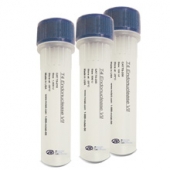
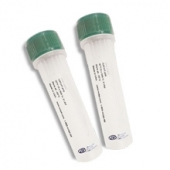
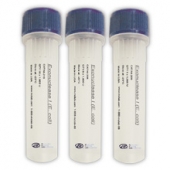
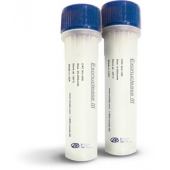
Benzonase endonuclease from Serratia marcescens, can be used to degrade all forms of DNA and RNA while having no proteolytic activity.
Description
Benzonase endonuclease from Serratia marcescens, can be used to degrade all forms of DNA and RNA while having no proteolytic activity. Benzonase endonuclease protein is a dimer of 30 kDa subunits with two essential disulfide bonds. This endonuclease attacks and degrades all forms of DNA and RNA (single stranded, double stranded, linear and circular) and is effective over a wide range of operating conditions. The optimum pH for enzyme activity is 8.0-9.2. It completely digests nucleic acids to 5′- monophosphate terminated oligonucleotides 3 to 5 bases in length. This is ideal for removal of nucleic acids from recombinant proteins and for applications where complete digestion of nucleic acids is desirable. It also reduces viscosity in protein extracts and prevents cell clumping. Pre-treatment of a protein sample improves its resolution on 2D gel electrophoresis by eliminating any bound nucleic acids.
Features
Easy operation, time saving
Lower priced, cost-effective
No typical protease activity
Steady product quality
High purity, low pollution
Be used in more than 2000 proteins' purification
Suitable for recombinant antibody's purification
Suitable for vaccine's purification
Applications
Digest native or heat-denatured DNA and RNA.
Prepare proteins in microcalorimetric experiments.
Reduce cell clumping during the preparation of chimeric cell mixtures.
Preparation of nuclear extracts by digesting DNA and releasing nuclear proteins intimately associated with DNA.
Used for the removal of nucleic acid from protein samples.
Unit Definition
One unit will digest sonicated salmon sperm DNA to acid-soluble oligonucleotides equivalent to a ΔA260 of 1.0 in 30 min at pH 8.0 at 37 °C (reaction volume 2.625 ml).
Purity
>95% determined by SDS-PAGE
Storage Conditions
50% Glycerol, 20 mM Tris HCl, pH 8.0, 2 mM MgCl2, 20 mM NaCl

CRISPR-Cas systems are powerful tools for mediating nucleic acids. Cas12a (also referred as Cpf1) nuclease belonging to the Class 2, Type V CRISPR system.
Adaptive immune systems from prokaryotes utilize clustered regularly interspaced short palindromic repeats (CRISPRs) and CRISPR associated (Cas) proteins to cleave foreign genetic material. CasRx, Cas13d from Ruminococcus flavefaciens XPD3002, is highly active and short, 94KD.
PFS 5′-GAAAG-3′
Origin: Sulfuricurvum sp. PC08-66
Purity > 95%
Cas9 Nuclease, Streptococcus pyogenes, is an RNA-guided endonuclease that catalyzes site-specific cleavage of double stranded DNA.
Fast and simple fragmentation
Fragment size easily controlled by incubation time
Ideal for NGS library preparation
Fast and simple fragmentation
Fragment size easily controlled by incubation time
Ideal for NGS library preparation
Adaptive immune systems from prokaryotes utilize clustered regularly interspaced short palindromic repeats (CRISPRs) and CRISPR associated (Cas) proteins to cleave foreign genetic material. CasRx, Cas13d from Ruminococcus flavefaciens XPD3002, is highly active and short, 94KD.
Adaptive immune systems from prokaryotes utilize clustered regularly interspaced short palindromic repeats (CRISPRs) and CRISPR associated (Cas) proteins to cleave foreign genetic material. Cas13a, (previously referred to as C2c2) is part of the Type VI CRISPR-Cas system.
Benzonase endonuclease from Serratia marcescens, can be used to degrade all forms of DNA and RNA while having no proteolytic activity.